If you want the honest answer: porcelain is the lower-maintenance, more predictable choice for Dublin’s wet climate, but Indian sandstone still has a place if you want a natural stone look and you’re prepared to seal it and stay on top of cleaning. We lay both across Dublin every year and the right one really does depend on your garden, your budget and how much upkeep you’re willing to do.
What we actually see go wrong with each material in Dublin
Most of the sandstone complaints we get called out to are not really about the stone itself, they’re about how it was bought and laid. Indian sandstone is a natural product, so colour and texture vary from batch to batch, and cheaper, non-calibrated stone can have inconsistent thickness that leads to a wobbly, uneven patio if the person laying it isn’t checking each slab. We also see sandstone that was laid without sealing, and after two or three Irish winters it’s gone green with algae, especially on north-facing gardens in places like Drumcondra and Glasnevin where the patio sits in shade for most of the day.
With porcelain, the mistakes are different. It’s a manufactured product so it’s far more consistent, but it has to be exterior-grade porcelain (usually around 20mm thick) laid on a proper bedding system, not the thin indoor tile some people try to use outside. Get that wrong and you can get hollow sounding slabs or cracking where the base hasn’t been compacted properly. Porcelain doesn’t forgive a poor base the way a softer natural stone sometimes will.
How Dublin’s weather actually affects the choice
We get a lot of freeze-thaw over the winter, rain that sits around for days, and in older gardens around Dun Laoghaire, Blackrock and Rathfarnham, a lot of shade from mature trees that keeps the ground damp long after the rain stops. That combination is hard on porous materials. Indian sandstone is naturally porous, so it absorbs moisture, and if that moisture freezes it can cause flaking or surface damage over time, particularly on lower-grade stone. Good quality, correctly sealed sandstone copes fine, but it needs that maintenance kept up.
Porcelain is practically non-porous, so it barely absorbs water at all. That makes it much more resistant to frost damage and it won’t stain the way sandstone can from leaf litter, bird droppings or garden furniture left out all winter. If you’ve got a shaded, damp garden that never quite dries out between September and April, that’s exactly where we’d steer a client towards porcelain.
Looks, feel and how it suits Dublin gardens and house styles
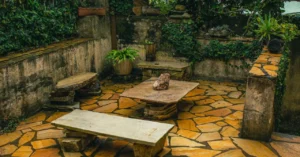
There’s no getting around it, Indian sandstone looks like a natural garden material because it is one. The slight colour variation, the riven texture, the way it weathers over the years, a lot of homeowners genuinely want that, especially in older gardens in Terenure or Rathmines with established planting where a very uniform, modern surface can look out of place.
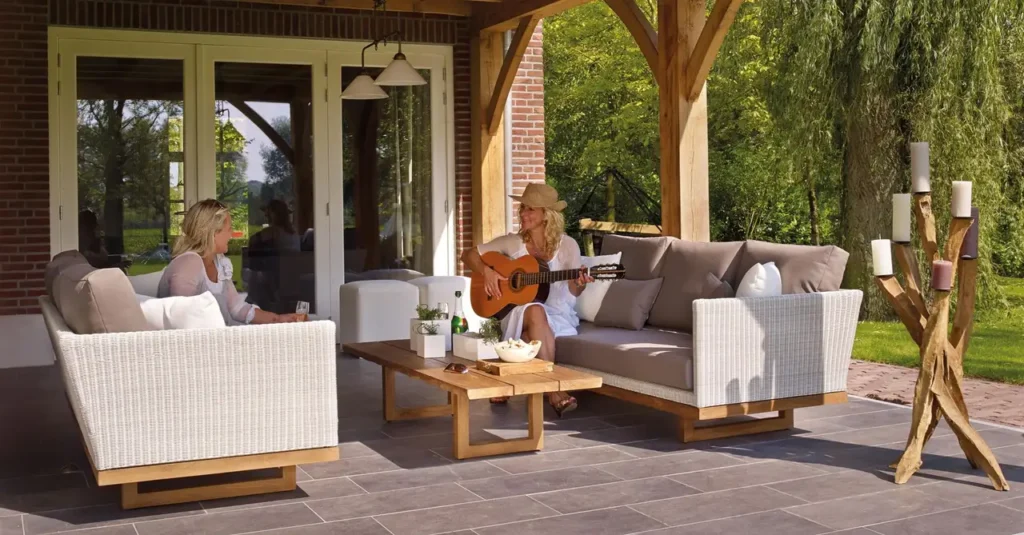
Porcelain suits a different look. It’s popular on the newer builds and extensions we work on around Stillorgan and Dundrum, where homeowners have put in large bifold or sliding doors and want the patio to flow visually from an interior tiled floor straight out into the garden. Porcelain comes in very consistent colours and large formats that give that clean, almost indoor-outdoor finish. If that’s the look you’re going for, porcelain is usually the better match.
Maintenance, realistically
This is where we’d push back on what a lot of people assume going in. Sandstone is not high maintenance in the sense of constant work, but it does need periodic sealing (roughly every couple of years depending on exposure and footfall) and an occasional proper clean to stop moss and algae building up, particularly in shaded Dublin gardens. Skip that and it will look tired within a few years, no matter how well it was laid.
Porcelain needs almost none of that. A wash down with water now and then keeps it looking new, and because it doesn’t absorb dirt or oil the way natural stone can, it stays cleaner for longer with far less effort. For a family that wants to enjoy the garden rather than maintain it, that’s a real point in porcelain’s favour.
What pushes the cost up or down
- Base condition: an old, uneven or poorly drained base costs more to dig out and rebuild properly, whatever surface goes on top.
- Access: tight side access common in Dublin terraces (Rathmines, Drumcondra, Dublin city) can mean hand-carrying materials, which adds labour time.
- Stone grade: calibrated, consistent-thickness sandstone costs more than non-calibrated stone but lays faster and more accurately.
- Porcelain thickness and format: larger format or thicker exterior porcelain generally costs more than standard sizes.
- Drainage and falls: gardens that already slope away from the house are cheaper to work with than flat, waterlogged sites needing new falls built in.
- Edging and features: steps, borders, drainage channels or a mix of materials all add to the job.
Because every garden is different, we’d always rather walk the site and give you an honest figure for your specific job than throw out a generic number that doesn’t hold up once we see the ground conditions.
Which one would we actually recommend?
If a Dublin client asks us straight out, and most do, our general steer is this: choose porcelain if low maintenance matters to you, if your garden is shaded or damp for a lot of the year, or if you want a patio that matches a modern extension. Choose Indian sandstone if you want a natural, traditional garden look, you’re happy to seal and clean it every couple of years, and you’re buying good calibrated stone rather than the cheapest pallet available. What we wouldn’t recommend is buying cheap, unsealed sandstone and expecting it to perform like porcelain, that mismatch is where most of the unhappy calls we get come from.
We lay both materials across Dublin and we’re happy to bring samples of each to your garden so you can see how they actually look in your light and against your house before you commit. You can read more about our porcelain patios and our Indian sandstone patios work, or get in touch through our contact page for a site visit and a proper quote.
Get the right advice before you commit
With over 26 years installing patios across Dublin, from Swords down to Dun Laoghaire, we’ve laid enough of both materials to know there’s no single “best” answer, only what’s best for your garden, your house and how you actually want to use the space. If you’re weighing up porcelain against Indian sandstone, have a look at our patio installation page or send us a few photos of your garden through the contact page and we’ll give you honest, straight advice, not a sales pitch.
Frequently Asked Questions
Is porcelain or Indian sandstone better for a Dublin garden that gets no direct sun?
For a shaded, damp garden we’d generally lean towards porcelain. It doesn’t absorb moisture, so it’s far less prone to the moss, algae and staining that build up on natural stone in low-light, damp conditions common across many older Dublin gardens.
Does Indian sandstone need sealing every year?
Not every year, but it does need sealing periodically, often every couple of years depending on footfall, exposure and the sealant used. Ask us to confirm a sensible schedule for your specific stone and garden when we quote the job.
Can porcelain crack in an Irish winter?
Good quality exterior-grade porcelain laid on a properly built base copes well with Irish freeze-thaw cycles. Cracking is almost always down to the wrong grade of tile, an unsuitable bedding system, or a poorly compacted base rather than the material itself failing.
Which is cheaper, porcelain or Indian sandstone?
It varies by supplier and the grade you choose, so we won’t quote a figure here that might be out of date by the time you read it. As a rule, base condition, access and the specific stone or tile you pick affect the final cost more than the material category does. Get in touch for a quote based on your actual garden.
Do I need planning permission for a new patio in Dublin?
Most standard patios are considered exempted development, but this can depend on the size, height and location of the work. Always check the current position with your local authority before starting, especially for larger or raised patios.
Can I mix porcelain and Indian sandstone in the same garden?
You can, and we’ve done it, often using porcelain near the house to match an extension and sandstone further out for a softer, more natural feel. It takes careful planning around levels and edging to make the transition look intentional rather than patchy.